
We seem to be operating in a Schrödinger’s Cat environment. We can’t see inside the box, yet the Market is infinitely confident that AI will eliminate the need for all human knowledge workers while also assuming that tech companies are vastly overspending to dominate this new market. Both can’t be true.
Companies may be overspending, but the cost of missing the train is far higher. More importantly, the fears of AI replacing all human capital are overdone.
In 1930, John Maynard Keynes predicted[1] that within a century technological advancements and increased productivity would lead to a world where people would only need to work 15 hours per week. Human material needs would be largely satisfied, allowing people to focus on leisure.
Have we finally reached that point?
History can be our guide:
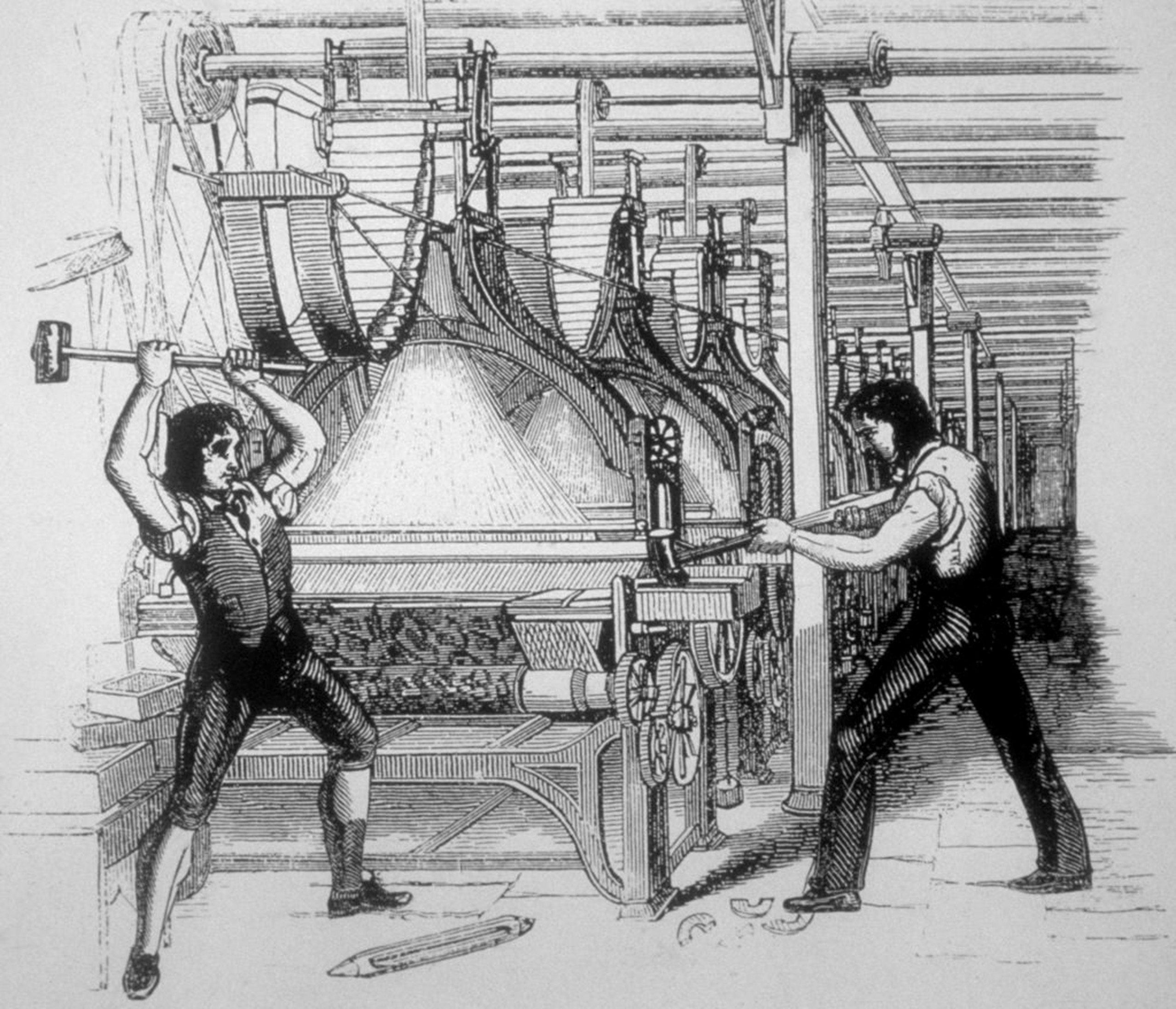
We should start with the Luddite Revolt and the Industrial Revolution (1810s–1840s)[2]. The original “Luddites” were skilled English textile workers who feared machines would make their craftsmanship obsolete. Their violent strategy was to smash power looms and stocking frames, burn down factories, and attack the private property of factory owners. During this period, many weavers did suffer wage cuts. But over the following decades, cheaper cloth expanded markets and British manufacturing employment grew immensely. The transition from agricultural to industrial labor produced the largest (up to that point) sustained increase in living standards in human history. It wasn’t until the 20th century that the term “Luddite” was re-popularized as a synonym for “technophobe.”
Warren Buffett and Charlie Munger have often referenced the Agricultural Revolution (1800s–early 1900s)[3] as an example of capitalism and technology enhancing the lives of Americans. In 1800, roughly 80–90% of Americans were engaged in farming or lived in rural farming communities reliant on subsistence living. The mechanization of agriculture (including the invention of reapers, threshers, tractors, and synthetic fertilizers) siphoned that employment share to under 3% today. The later invention of refrigerated transport meant that meat and other goods could be shipped to countries from as far afield as Argentina, Australia, and New Zealand allowing countries to specialize in agricultural products best suited for their climate. The combination of mechanization and specialization brought tremendous efficiency gains, reducing both labor and food costs. People can now eat more, and arguably better, as a result. (Calf’s head, anyone?) The displaced farm labor migrated to employment in factories, railroads, schools, and the service industries. America became far wealthier precisely because fewer people were needed to feed the populace.
“If somebody asked that question 200 years ago and said, ‘With the outlook for development of farm machinery, tractors, and combines, meaning 90% of the people on farms were going to lose their job,’ it would look terrible, wouldn’t it? But our economy, our people, and our system, has been remarkably ingenious in achieving whatever we have now [] That’s what capitalism does. It produces more and more goods per person. We never know exactly where they’re going to come from, but we find ways, in this economy, to employ more and more people.” – Warren Buffett
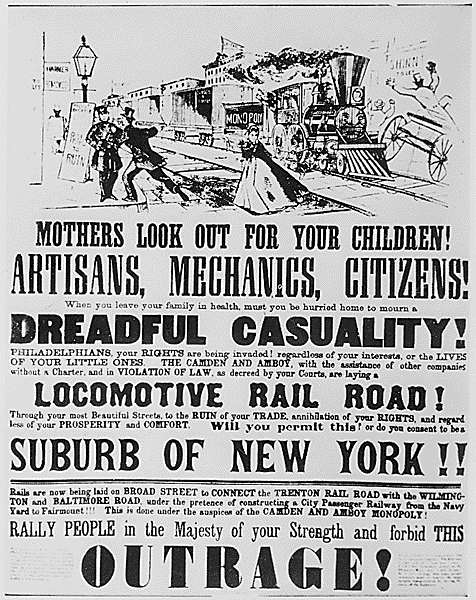
The impact and subsequent value creation of the Steam Engine and Railroads (1820s–1880s)[4] is obvious. However, the interesting history is the reaction from those resistant to change including canal workers, horse teamsters, and ship sailing crews. Opponents of the technologies filed legal objections, refused land access, and at times sabotaged construction sites. Pamphlets condemned the railway as destructive to the environment with cartoons depicting trains flattening wildlife or plowing through sacred sites. Fears spread that iron tracks would bring fire and noise, while trains would kill livestock and scare children. Critics lamented long-term cultural effects asserting that trains weakened local identity by drawing distant towns together and encouraging mass migration. Physicians warned of physical and mental breakdowns because some patients experienced nausea, confusion, and memory lapses after train travel. Doctors and journalists coined the term “railway spine” to describe the symptoms for passengers involved in railway accidents.
One of the most cited economic references to technology counterintuitively creating jobs is the ATM’s impact on Banking (1970s–1990s)[5]. Introduced in the 1970s, the ATM was expected to eliminate bank tellers. The number of tellers per branch declined but, because ATMs reduced bank operating costs and having more bank branches was good for marketing, banks opened more branches. Over the subsequent two decades, the total number of bank tellers increased. Meanwhile, freed from cash handling responsibilities, tellers evolved to the “customer relationship team.”

Electricity and Factory Automation (1880s–1920s) didn’t eliminate skilled trades but instead it increased the output of manufactured goods. As prices fell, factory employment increased, and new categories of work (electrical engineering, appliance manufacturing, radio and film industries) emerged.
The Personal Computer (1980s–2000s) eliminated roles for clerical workers, typists, and bookkeepers but created software developers, network administrators, IT support, web designers, digital marketers, and e-commerce. None of these roles existed before.
And lastly, Internet and E-Commerce (1990s–2010s) eroded employment for retailers, travel agents, stockbrokers, and newspapers. Amazon is the poster child for market disruption having displaced the traditional retail market, and yet Amazon employs almost 1.6 million people. And the internet simultaneously created cloud computing, SaaS, streaming entertainment, the gig economy, and the creator economy.
What does this mean for AI?
A labor market report based on LinkedIn data[6] highlighted that AI has already created 1.3M new AI related jobs. And this figure does not include the numerous construction jobs tied to building the datacenters AI relies on. The fear that AI will cause a permanent, irreversible collapse of human employment runs counter to almost every historical precedent. In each period of disruption, technology raises productivity growth which boosts demand and creates jobs. Human displacement is particularly acute for workers who cannot retrain; however, new job opportunities emerge in job categories which were never imagined or predicted. It takes time, but humans always migrate up the value chain toward tasks requiring more judgment, creativity, and relationship building — areas where we have a durable advantage. We expect this next generation of technology disruption to be the same.
“I don’t think we need to worry about American ingenuity running out. If you look at all kinds of businesses, people like to make money, but they really like to be inventive. They like to do things. This economy works. It will continue to work. [ ] I don’t know what the next big thing will be. I do know there will be a next big thing.” – Warren Buffett, (2019 Annual Shareholder meeting, emphasis ours)
[1] 1930 essay, Economic Possibilities for Our Grandchildren
[2] https://www.history.com/articles/who-were-the-luddites
[3] https://foodsystemprimer.org/production/industrialization-of-agriculture
[4] https://www.historyskills.com/classroom/year-9/steam-train-fears/
[5] https://www.imf.org/external/pubs/ft/fandd/2015/03/bessen.htm
[6] https://www.weforum.org/stories/2026/01/ai-has-already-added-1-3-million-new-jobs-according-to-linkedin-data/
Leave a Reply